KI-generert løsningsforslag. Dette løsningsforslaget er skrevet av en språkmodell (Claude) og er ikke verifisert av lærer. Det kan inneholde regnefeil, upresis bruk av begreper eller mangler.
a)
Vi ser etter x x x slik at g ( x ) = 0 g(x) = 0 g ( x ) = 0 :
1 2 e x ⋅ ( 2 x − 1 ) 2 = 0 \frac{1}{2}e^x \cdot (2x-1)^2 = 0 2 1 e x ⋅ ( 2 x − 1 ) 2 = 0
Et produkt er null når minst én faktor er null. Siden e x > 0 e^x > 0 e x > 0 for alle x x x , og 1 2 > 0 \frac{1}{2} > 0 2 1 > 0 , må
( 2 x − 1 ) 2 = 0 ⟹ 2 x − 1 = 0 ⟹ x = 1 2 (2x-1)^2 = 0 \implies 2x - 1 = 0 \implies x = \frac{1}{2} ( 2 x − 1 ) 2 = 0 ⟹ 2 x − 1 = 0 ⟹ x = 2 1
g g g har ett nullpunkt: x = 1 2 x = \dfrac{1}{2} x = 2 1 (dobbelt nullpunkt).
b)
Vi deriverer g ( x ) = 1 2 e x ⋅ ( 2 x − 1 ) 2 g(x) = \dfrac{1}{2}e^x \cdot (2x-1)^2 g ( x ) = 2 1 e x ⋅ ( 2 x − 1 ) 2 med produktregelen ( u v ) ′ = u ′ v + u v ′ (uv)' = u'v + uv' ( uv ) ′ = u ′ v + u v ′ :
u = 1 2 e x , u ′ = 1 2 e x u = \frac{1}{2}e^x, \quad u' = \frac{1}{2}e^x u = 2 1 e x , u ′ = 2 1 e x
v = ( 2 x − 1 ) 2 , v ′ = 2 ( 2 x − 1 ) ⋅ 2 = 4 ( 2 x − 1 ) v = (2x-1)^2, \quad v' = 2(2x-1) \cdot 2 = 4(2x-1) v = ( 2 x − 1 ) 2 , v ′ = 2 ( 2 x − 1 ) ⋅ 2 = 4 ( 2 x − 1 )
Dermed:
g ′ ( x ) = 1 2 e x ⋅ ( 2 x − 1 ) 2 + 1 2 e x ⋅ 4 ( 2 x − 1 ) g'(x) = \frac{1}{2}e^x \cdot (2x-1)^2 + \frac{1}{2}e^x \cdot 4(2x-1) g ′ ( x ) = 2 1 e x ⋅ ( 2 x − 1 ) 2 + 2 1 e x ⋅ 4 ( 2 x − 1 )
Vi faktoriserer ut 1 2 e x ( 2 x − 1 ) \dfrac{1}{2}e^x(2x-1) 2 1 e x ( 2 x − 1 ) :
g ′ ( x ) = 1 2 e x ( 2 x − 1 ) [ ( 2 x − 1 ) + 4 ] = 1 2 e x ( 2 x − 1 ) ( 2 x + 3 ) g'(x) = \frac{1}{2}e^x(2x-1)\bigl[(2x-1) + 4\bigr] = \frac{1}{2}e^x(2x-1)(2x+3) g ′ ( x ) = 2 1 e x ( 2 x − 1 ) [ ( 2 x − 1 ) + 4 ] = 2 1 e x ( 2 x − 1 ) ( 2 x + 3 )
Dette er det vi skulle vise. □ \square □
c)
Vi setter g ′ ( x ) = 0 g'(x) = 0 g ′ ( x ) = 0 :
1 2 e x ( 2 x − 1 ) ( 2 x + 3 ) = 0 \frac{1}{2}e^x(2x-1)(2x+3) = 0 2 1 e x ( 2 x − 1 ) ( 2 x + 3 ) = 0
Siden 1 2 e x > 0 \dfrac{1}{2}e^x > 0 2 1 e x > 0 for alle x x x , må
( 2 x − 1 ) ( 2 x + 3 ) = 0 ⟹ x = 1 2 eller x = − 3 2 (2x-1)(2x+3) = 0 \implies x = \frac{1}{2} \quad \text{eller} \quad x = -\frac{3}{2} ( 2 x − 1 ) ( 2 x + 3 ) = 0 ⟹ x = 2 1 eller x = − 2 3
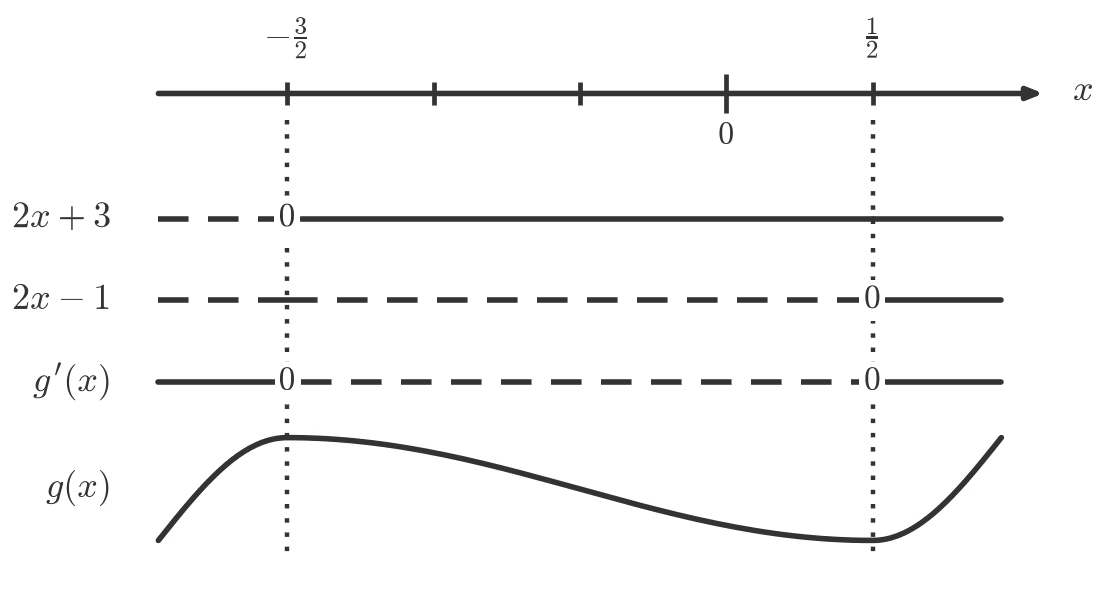
Fortegnsskjema for g ′ ( x ) = 1 2 e x ⋅ ( 2 x − 1 ) ⋅ ( 2 x + 3 ) g'(x) = \frac{1}{2}e^x \cdot (2x-1) \cdot (2x+3) g ′ ( x ) = 2 1 e x ⋅ ( 2 x − 1 ) ⋅ ( 2 x + 3 ) :
x < − 3 2 x < -\dfrac{3}{2} x < − 2 3 x = − 3 2 x = -\dfrac{3}{2} x = − 2 3 − 3 2 < x < 1 2 -\dfrac{3}{2} < x < \dfrac{1}{2} − 2 3 < x < 2 1 x = 1 2 x = \dfrac{1}{2} x = 2 1 x > 1 2 x > \dfrac{1}{2} x > 2 1 ( 2 x + 3 ) (2x+3) ( 2 x + 3 ) − - − 0 0 0 + + + + + + + + + ( 2 x − 1 ) (2x-1) ( 2 x − 1 ) − - − − - − − - − 0 0 0 + + + g ′ ( x ) g'(x) g ′ ( x ) + + + 0 0 0 − - − 0 0 0 + + + g g g ↗ \nearrow ↗ topp ↘ \searrow ↘ bunn ↗ \nearrow ↗
g g g har toppunkt i x = − 3 2 x = -\dfrac{3}{2} x = − 2 3 og bunnpunkt i x = 1 2 x = \dfrac{1}{2} x = 2 1 .
Funksjonsverdi i toppunktet:
g ( − 3 2 ) = 1 2 e − 3 / 2 ⋅ ( 2 ⋅ ( − 3 2 ) − 1 ) 2 = 1 2 e − 3 / 2 ⋅ ( − 4 ) 2 = 1 2 e − 3 / 2 ⋅ 16 = 8 e − 3 / 2 g\!\left(-\frac{3}{2}\right) = \frac{1}{2}e^{-3/2} \cdot \left(2 \cdot \left(-\frac{3}{2}\right) - 1\right)^2 = \frac{1}{2}e^{-3/2} \cdot (-4)^2 = \frac{1}{2}e^{-3/2} \cdot 16 = 8e^{-3/2} g ( − 2 3 ) = 2 1 e − 3/2 ⋅ ( 2 ⋅ ( − 2 3 ) − 1 ) 2 = 2 1 e − 3/2 ⋅ ( − 4 ) 2 = 2 1 e − 3/2 ⋅ 16 = 8 e − 3/2
Funksjonsverdi i bunnpunktet:
g ( 1 2 ) = 1 2 e 1 / 2 ⋅ ( 2 ⋅ 1 2 − 1 ) 2 = 1 2 e 1 / 2 ⋅ 0 = 0 g\!\left(\frac{1}{2}\right) = \frac{1}{2}e^{1/2} \cdot (2 \cdot \tfrac{1}{2} - 1)^2 = \frac{1}{2}e^{1/2} \cdot 0 = 0 g ( 2 1 ) = 2 1 e 1/2 ⋅ ( 2 ⋅ 2 1 − 1 ) 2 = 2 1 e 1/2 ⋅ 0 = 0
Toppunkt: ( − 3 2 , 8 e − 3 / 2 ) ≈ ( − 1,5 ; 1,78 ) \left(-\dfrac{3}{2},\ 8e^{-3/2}\right) \approx \left(-1{,}5;\ 1{,}78\right) ( − 2 3 , 8 e − 3/2 ) ≈ ( − 1 , 5 ; 1 , 78 )
Bunnpunkt: ( 1 2 , 0 ) \left(\dfrac{1}{2},\ 0\right) ( 2 1 , 0 )